The digital world is a vast, interconnected web, and somewhere within it, your personal information is likely being bought, sold, and traded without your explicit consent. Data brokers aggregate everything from your address and phone number to your shopping habits and political leanings, packaging it into profiles that can fuel spam, scams, and even identity theft. Navigating this labyrinth to reclaim your privacy is a monumental task, which is why services like Incogni have emerged. But how does Incogni stack up against the competition? This comprehensive guide offers an Incogni vs. Competitors: A Comparative Analysis, designed to help you choose the best data removal service for your unique privacy needs.
At a Glance: Key Takeaways for Data Removal Services
- Incogni excels in automation and breadth for non-public data brokers, making it a "set it and forget it" solution, especially for marketing and risk mitigation databases.
- Competitors like Onerep and DeleteMe often provide more granular detail and verification for people-search sites, showing actual profile links and screenshots.
- Key factors to consider include the number and types of brokers covered (public vs. non-public), scanning capabilities, transparency in tracking, ongoing monitoring, and pricing.
- No single service is perfect; each has strengths and weaknesses regarding coverage, transparency, and cost. Your choice depends on your specific privacy priorities.
- Manual removal is arduous but free, though significantly less effective and time-consuming than automated services.
The Silent Threat: Why Your Data is Everywhere (And Why It Matters)
Imagine a world where your daily activities – from what you buy online to the causes you support – are meticulously recorded, analyzed, and then sold to anyone willing to pay. This isn't a dystopian fantasy; it's the reality of the data broker industry. These companies harvest personal information from public records, social media, online activities, and commercial transactions, compiling detailed profiles on virtually everyone.
The implications are far-reaching: a barrage of targeted spam emails, annoying telemarketing calls, increased vulnerability to phishing scams, and even the potential for identity theft. For some, having their address or phone number publicly listed can even pose personal safety risks. Protecting yourself means understanding the deeper risks posed by understanding the deeper risks posed by data brokers and proactively removing your data from these digital dossiers.
Understanding Your Shield: What Data Removal Services Really Do
Given the sheer volume of data brokers and the opaque nature of their operations, manually opting out of each one is an exercise in futility. It's a never-ending game of whack-a-mole, where new brokers emerge and old ones re-list your data. This is where data removal services come in.
These services act as your digital proxy, automating the cumbersome process of sending opt-out requests to data brokers on your behalf. They leverage privacy regulations like GDPR and CCPA to demand the removal of your personal information. But not all services are created equal. Some cast a wide net, others specialize, and their methods for verification and ongoing monitoring vary significantly.
Deciding Factors: How to Choose Your Digital Guardian
Before diving into specific comparisons, it's crucial to understand the benchmarks by which data removal services should be judged. These seven factors will guide you in selecting the best service to protect your privacy:
1. Number and Types of Data Brokers Covered
This isn't just about raw numbers; it's about quality. A service claiming to cover "thousands" might mostly target obscure marketing databases, while one covering "hundreds" might focus intensely on high-risk people-search sites.
- People-Search Sites: These are public-facing directories (e.g., WhitePages, Spokeo) where anyone can find your address, phone number, age, and even family members. They pose immediate risks for scams, harassment, and identity theft. Prioritize services that robustly tackle these.
- Marketing Brokers: These maintain private databases used for targeted advertising, lead generation, and analytics. While less publicly visible, they contribute to spam and surveillance.
- Risk Mitigation/Recruitment Brokers: These are used by businesses for background checks, fraud detection, or talent sourcing.
Your Takeaway: Look beyond the total count. Does the service effectively target the types of brokers that pose the most significant risk to you, particularly people-search sites?
2. Scanning Capabilities
A service that merely sends requests to brokers without verifying if your data is actually present is less effective than one that scans and confirms.
- Pre-request Scanning: Can the service scan people-search sites to confirm your data exists before sending an opt-out request? This prevents potentially exposing your information to a broker who didn't have it.
- Post-removal Verification: After a request is sent, does the service verify that your data has indeed been removed? This is critical for ensuring compliance and avoiding false positives.
Your Takeaway: Robust scanning for verification (both before and after) indicates a more thorough and transparent service.
3. Tracking Removal Progress and Transparency
Knowing what's happening behind the scenes is key to trusting a service.
- Clear Dashboard: Does the service provide an intuitive dashboard that shows overall progress and individual site statuses?
- Specific Details: Can you see which specific pieces of your data were found on each site? Are there links to exposed profiles or screenshots of your data before and after removal?
- Evidence of Removal: How does the service demonstrate that your data has been removed? Is it just a "removed" status, or is there tangible proof?
Your Takeaway: Prioritize services that offer high transparency, providing clear evidence of data presence and removal.
4. Ongoing Monitoring
Data brokers are dynamic. Your information can reappear on old sites or pop up on new ones.
- Regular Scans: How often does the service re-scan for your data? Monthly, quarterly, or on an ad-hoc basis?
- Proactive Requests: Does it automatically send new opt-out requests if your data reappears?
Your Takeaway: Continuous monitoring is essential for long-term privacy protection. A "one-and-done" service isn't truly effective.
5. Customer Support
Even with automated services, questions and issues can arise.
- Accessibility: How can you reach support (email, chat, phone)?
- Responsiveness: How quickly do they respond?
- Helpfulness: Are they knowledgeable and able to resolve issues effectively?
Your Takeaway: Good customer support adds significant value, especially when dealing with sensitive personal data.
6. User Reviews
Real-world experiences offer invaluable insights that marketing materials might miss.
- Review Platforms: Check sites like Trustpilot, BBB, and app stores.
- Common Themes: Look for recurring praise or complaints about coverage, effectiveness, support, or billing.
Your Takeaway: User reviews can highlight common pain points or exceptional features not immediately apparent.
7. Pricing
Data removal services typically operate on a subscription model (monthly or annually).
- Cost vs. Value: Does the price align with the service's quality, coverage, and transparency?
- Free Trials/Scans: Many offer a free scan or trial period, allowing you to assess their value before committing.
- Family Plans: Consider family plans if you need to protect multiple individuals.
Your Takeaway: Balance cost with the depth and effectiveness of the service. Cheaper isn't always better if it means less comprehensive protection.
Incogni Under the Microscope: A Deep Dive
Incogni, owned by cybersecurity giant Surfshark, aims to be your automated solution for data removal. It’s designed to lift the heavy burden of manual opt-outs, promising a simpler path to digital privacy.
Function and Coverage
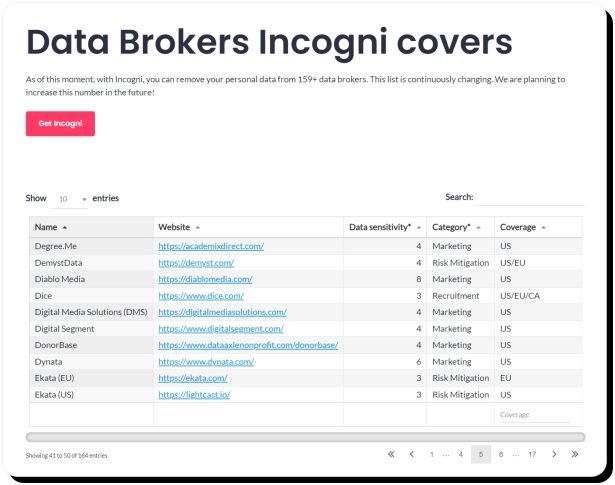
Incogni's primary function is to automate personal data removal requests from a wide array of data brokers. It boasts coverage for over 406+ brokers, primarily targeting non-public databases categorized as marketing, risk mitigation, and recruitment brokers. It also includes some people-search sites.
The Incogni Process
- Prediction Algorithm: Incogni uses an algorithm to predict which data brokers are likely to hold your personal information. This is a key distinction from services that actively scan public sites.
- Automated Requests: Based on these predictions, Incogni automatically sends official opt-out requests to relevant brokers. These requests are grounded in strong privacy frameworks like GDPR (General Data Protection Regulation) and CCPA (California Consumer Privacy Act).
- Monitoring and Follow-ups: The service monitors for data reappearance and sends follow-up requests as needed. It can also place users on "suppression lists" to prevent data re-collection by some brokers.
- Updates: You receive weekly progress updates via email and can track activity on a 24/7 dashboard.
Incogni's Limitations
While Incogni offers a convenient automated service, it's essential to understand its limitations:
- Limited Scanning for Verification: Incogni cannot actively scan most non-public data brokers to verify if your data is held before sending a request. This means requests are sent proactively, potentially alerting new entities to your existence or data.
- Verification Reliance: For non-public sites, Incogni relies solely on broker confirmations for removal verification. There’s no independent audit or visual confirmation.
- Transparency Gaps for People-Search Sites: The dashboard doesn't typically show specific personal details found, direct links to exposed pages, or screenshots of your profiles on people-search sites. This can make it hard to verify what was removed.
- User Assistance Required: Some removal confirmations may still require user assistance, pulling you into the process you hoped to automate.
- Feature Set: Incogni is a focused data removal service. It does not offer additional privacy features like dark web monitoring, email masking, or antivirus protection, which some competitors or broader security suites provide.
- Pricing: No standalone free version is available, though it does offer a 30-day money-back guarantee. It’s also offered as a free add-on to the Surfshark ONE service.
Ownership
Incogni is owned by Surfshark, a well-known VPN provider, positioning it within a broader suite of digital privacy tools.
For those wondering, Is Incogni worth it? often comes down to weighing its automation benefits against these transparency limitations.
The Contenders: Incogni's Top Competitors Face Off
Now, let's pit Incogni against some of its strongest rivals, examining their approaches to data removal.
1. Onerep: The People-Search Specialist
Onerep stands out with its laser focus on people-search sites and robust verification capabilities.
- Focus: 235 people-search sites. While this number is lower than some general data broker counts, Onerep's specialization means it targets the most publicly visible and risky data sources.
- Key Features:
- TrueScanTM Technology: Onerep actively scans sites to find your data and verify its removal, offering a higher degree of confidence than services relying on broker confirmations.
- Detailed Dashboard: Provides a highly transparent view of your data, showing found personal details, direct links to exposed pages, and clear removal statuses.
- Monthly Scans: Ensures ongoing monitoring, detecting new exposures or reappearances.
- Flexibility: Allows for unlimited aliases, addresses, emails, and phone numbers.
- Family Plans: Offers protection for up to 6 people.
- Pricing:
- Individual: $14.95/month or $99.95/year.
- Family (up to 6): $27.95/month or $179.95/year.
- Offers a free scan, a 5-day free trial, and a 30-day money-back guarantee.
- Pros: Strong focus on high-risk people-search sites, verifiable scanning and removal, highly transparent dashboard with direct links, excellent ongoing monitoring, supports multiple aliases, family plans available, free trial.
- Cons: Fewer total data brokers covered compared to services that also target marketing databases, potentially higher cost than Incogni for individual plans.
2. DeleteMe: The Veteran with a Hybrid Approach
DeleteMe is one of the longest-running services in the data removal space, offering a mix of automated and manual processes.
- Coverage: Boasts 750+ data broker sites overall, with its standard plan covering around 100 sites, primarily focusing on people-search sites.
- Key Features:
- Hybrid Process: Employs both automated tools and human intervention to handle removal requests.
- Quarterly Reports: Provides detailed privacy reports listing brokers, statuses, and some links to exposed profiles.
- Multiple Identities: Allows for multiple aliases, addresses, phone numbers, and email addresses.
- Additional Privacy Tools: Offers free email masking and optional phone number masking ($7/line).
- Limitations:
- Limited Custom Requests: Only allows up to 40 custom removal requests per year, which might be restrictive for unique cases.
- Minimal Dashboard Details: The online dashboard shows overall progress but often lacks granular, individual site details.
- Quarterly Reporting: Reports are issued only quarterly, meaning less frequent updates on removal progress.
- Annual Billing Only: Requires an annual commitment, with no monthly payment options.
- Pricing:
- Single: $129/year.
- Couple: $229/year.
- Family (4 people): $329/year.
- Offers a free scan and a pro-rated refund policy.
- Pros: High overall broker coverage (especially people-search), offers additional privacy features (masking), pro-rated refund, free initial scan.
- Cons: Standard plan's broker coverage is limited, custom request limits, less frequent updates, no monthly plans, more expensive than some competitors, dashboard lacks immediate transparency.
3. Privacy Bee: The Broad-Spectrum Manager
Privacy Bee takes a broader approach to privacy, extending beyond just data broker removal.
- Coverage: Covers over 300 sites, including non-public databases, lead-generation platforms, and people-search websites.
- Key Features:
- "Trust Management": A unique feature that allows users to mark companies as "trusted" to manage data sharing preferences.
- People-Search Scanning: Scans people-search sites and provides links in the dashboard.
- Multiple Identity Support: Handles multiple emails, aliases, addresses, and phone numbers.
- Additional Tools: Offers a "house blur" feature for mapping services, a free browser extension (tracker blocker), and a Gmail inbox scan for data tracking.
- Limitations:
- Slow Request Rate: Sends only 2-3 opt-out requests per day, and brokers are given 60 days to respond, making the removal process significantly slower.
- Limited Scanning/Verification: Cannot scan most covered brokers or verify compliance for non-public sites, similar to Incogni. This means sending requests without verifying data presence, potentially exposing information.
- User Input Required: Often requires user input for confirmation emails, diminishing the "set it and forget it" promise.
- Annual Billing Only: No monthly options.
- Pricing: $197/year/user. Offers a 30-day money-back guarantee.
- Pros: Broad broker coverage, unique trust management feature, useful additional privacy tools, scans people-search sites.
- Cons: Very slow request rate, unable to scan most brokers (potential data exposure), requires user confirmation, expensive, no family discounts, no monthly plans.
4. Kanary Copilot: The Hands-On Mobile Assistant
Kanary Copilot (from Kanary) offers a more interactive, mobile-first approach to online safety.
- Focus: Automates removals from around 10 common people-search sites, with a broader goal of general "online safety actions."
- Key Features:
- Interactive Tasks: Breaks down privacy tasks into small, manageable steps, allowing users to review and approve each removal action. This means it's not fully automated.
- Live Scanning: Scans people-search sites live, showing users what's found.
- Mobile-First: Designed as an iOS app (currently no Android).
- Limitations:
- Limited Automation: Requires user input for each broker, which can be time-consuming.
- Very Limited Coverage: Only covers approximately 10 data broker sites, significantly less than all other competitors.
- Mobile-Only: Exclusively an iOS app, limiting accessibility.
- Pricing:
- Free app with basic features.
- Premium tier ($9.99/month) for unlimited names, emails, phone numbers, and early access to more automations.
- Family add-ons are 50% off for Premium users.
- Pros: Free basic app, live scanning of people-search sites, bite-sized tasks make it less daunting, in-app chat support.
- Cons: Very limited broker coverage, not fully automated, iOS-only. Best for those who prefer a hands-on approach and only need to tackle a few major sites.
5. Optery: The Tiered Transparency Provider
Optery offers tiered services with varying levels of coverage and transparency, focusing on visual proof of removal.
- Coverage: Ranges from 85 to 605+ sites depending on the plan, including both people-search sites and some non-public databases.
- Key Features:
- Visual Proof: Auto-generates links to likely exposed pages on people-search sites and provides screenshots of found profiles in the dashboard and PDF reports.
- Before-and-After Screenshots: Extended and Ultimate plans include quarterly reports with visual comparisons of profiles before and after removal.
- Multiple Identities: Unlimited name variations, addresses, phone numbers, and email addresses for Extended and Ultimate plans.
- Free Plan: Offers a basic free plan with quarterly scans.
- Limitations:
- Partial Scanning: Does not fully scan people-search websites, potentially missing some data.
- Misleading Dashboard: The dashboard can sometimes be misleading with faulty links or combined "Removed/Not found" statuses that exaggerate removal progress.
- Non-public Broker Issues: Cannot scan non-public data brokers, meaning requests are sent without verification, potentially exposing data to sites that didn't have it.
- Limited Email/Phone Scanning: Only scans for one email and phone number at a time on lower tiers.
- Paywalled Key Sites: Some prominent people-search sites are locked behind more expensive plans.
- Pricing:
- Core (85+ sites): $3.99/month or $39/year.
- Extended (240+ sites): $14.99/month or $149/year.
- Ultimate (365+ to 605+ sites): $24.99/month or $249/year.
- Offers family discounts.
- Pros: Good broker coverage on higher plans, strong visual proof (screenshots, links), quarterly reports, free plan available, family discounts.
- Cons: Potential data exposure to new sites, dashboard issues, exaggerated claims, limited email/phone scanning on lower tiers, some key sites are on premium plans.
Quick Comparison Table: Incogni vs. Top Competitors
| Feature | Incogni | Onerep | DeleteMe | Privacy Bee | Kanary Copilot | Optery |
|---|---|---|---|---|---|---|
| Primary Focus | Broad data brokers (non-public, some public) | People-search sites (public) | People-search sites (public) | Broad data brokers + general privacy management | People-search sites (public) | Broad data brokers (public & non-public) |
| Brokers Covered | 406+ (non-public & some public) | 235 (people-search) | 750+ (100 in Standard plan) | 300+ (incl. non-public, people-search) | ~10 (people-search) | 85-605+ (plan dependent) |
| Scanning Verification | Algorithm predicts, no pre-scan verification | TrueScan™ (scans & verifies before/after) | Mix of automated/manual, less transparent scan | Scans people-search; no pre-scan for non-public | Live scans people-search | Auto-generates links, scans for visual proof |
| Dashboard Transparency | Overall status, weekly updates; no links/screenshots | Highly detailed (links, details) | Overall status, quarterly reports with some links | Links for people-search; user input for others | Interactive, shows matches & actions | Screenshots/links; dashboard can be misleading |
| Ongoing Monitoring | Yes, re-sends requests | Monthly scans | Quarterly reports | Limited by slow request rate | On-demand scans | Quarterly on paid plans |
| Pricing (Annual) | ~$78/year (often bundled with Surfshark) | $99.95/year (individual) | $129/year (individual) | $197/year/user | Free (basic), $119.88/year (premium) | $39 - $249/year (plan dependent) |
| Free Options | 30-day money-back; free with Surfshark ONE | Free scan & 5-day trial | Free scan | 30-day money-back; free browser extension | Free basic app | Free plan with quarterly scans |
| Key Strengths | High automation, broad non-public coverage | Excellent people-search focus & transparency | High overall broker count, additional features | Broad privacy features, unique trust mgmt | Free basic plan, interactive removal, mobile-first | Visual proof, tiered pricing, family discounts |
| Key Limitations | Limited verification transparency, no extra features | Fewer total brokers | Quarterly reports only, limited dashboard detail | Slow removal, high cost, limited verification | Very limited coverage, requires user input, iOS-only | Misleading dashboard, potential data exposure |
| Note: Pricing is approximate and subject to change. |
Incogni vs. The Pack: Who Wins for What Needs?
Choosing the right service hinges on your specific priorities.
- For "Set It and Forget It" Automation (Especially Non-Public Data): Incogni
If your main goal is to broadly reduce your digital footprint on marketing, risk mitigation, and recruitment brokers with minimal effort on your part, Incogni is a strong contender. Its strength lies in its automation and wide reach for these less visible databases. It's particularly appealing if you're already a Surfshark ONE user, getting it as an add-on. - For Maximum Transparency and Verifiable Removal from People-Search Sites: Onerep
If your primary concern is the public availability of your data on people-search sites, and you want undeniable proof of removal with direct links and screenshots, Onerep is likely your best bet. Its TrueScan™ technology and highly detailed dashboard offer peace of mind that Incogni and some others can't match for public data. - For Comprehensive Coverage with Extra Privacy Features: DeleteMe
If you're looking for a service that covers a large number of brokers (especially people-search) and also offers valuable add-ons like email and phone masking, DeleteMe presents a robust package. Its hybrid approach aims for thoroughness, though you'll need to be okay with quarterly updates. - For Broader Privacy Management and Additional Tools: Privacy Bee
If your privacy concerns extend beyond just data broker removal to include managing permissions and blocking trackers, Privacy Bee's unique feature set and additional tools might be appealing. However, be prepared for a slower removal process and a higher price tag. - For Budget-Conscious Users Who Prefer a Hands-On Mobile Approach: Kanary Copilot
If you're okay with actively managing your data removal from a select few major people-search sites and prefer a mobile app interface, Kanary Copilot's free tier offers a good starting point. It's not for those seeking full automation or broad coverage. - For Visual Proof of Removal from People-Search Sites (with caveats): Optery
Optery's focus on providing screenshots and links for found profiles is a significant advantage for visual learners who want concrete proof. However, be mindful of its limitations regarding non-public brokers and potential dashboard inaccuracies, especially on lower-tier plans.
Beyond Removal: Holistic Data Protection
While data removal services are powerful tools, they are just one component of a robust digital privacy strategy.
Aura vs. Incogni: A Matter of Focus
A common question is how Incogni compares to broader security suites like Aura. The key difference lies in their focus:
- Incogni: Exclusively focuses on automating personal data removal from data brokers (200-400+ brokers).
- Aura: Offers a much broader security suite including identity theft protection, credit monitoring, a VPN, antivirus software, a password manager, and spam call protection. However, Aura typically covers fewer data brokers (around 20-30) for removal.
Your Takeaway: If data removal is your sole priority, Incogni is more specialized. If you want an all-in-one identity and digital security solution that includes some data removal, Aura might be a better fit.
Removing Information from the Internet for Free: The Manual Gauntlet
Is it possible to remove your information from the internet for free? Yes, but it's an incredibly time-consuming and often frustrating endeavor. You can significantly reduce your digital footprint by:
- Manual Opt-Outs: Directly visiting each data broker's website and following their specific opt-out procedures. This often involves filling out forms, providing identity verification, and potentially sending physical mail. This process for manual data removal guide can take dozens of hours and needs to be repeated regularly.
- Closing Unused Accounts: Deactivating old social media profiles, defunct shopping accounts, and other online services you no longer use.
- Adjusting Privacy Settings: Tightening privacy settings on social media platforms, search engines, and other services.
- Monitoring Search Engines: Regularly searching for your name to identify new exposures.
- Disabling Cookies and Trackers: Using browser extensions and privacy-focused browsers to limit online tracking.
While these steps can help, they rarely achieve the comprehensive, ongoing removal offered by dedicated services. It's a significant commitment of time and effort for potentially limited results. For a truly effective and continuous defense, considering broader online privacy tips and a paid service is often the pragmatic choice.
The Bigger Picture: Identity Theft Prevention
Beyond data brokers, your digital privacy is tied to your overall cybersecurity posture. Data removal services reduce the attack surface, making it harder for criminals to find and exploit your information. However, they don't replace the need for strong passwords, two-factor authentication, vigilance against phishing, and a plan for comprehensive identity theft prevention.
Understanding key privacy frameworks like key privacy frameworks like GDPR and CCPA is also crucial, as these are the legal levers data removal services use.
The Enduring Battle: Your Next Steps for Digital Privacy
The fight for digital privacy is an ongoing one, but you don't have to face it alone. Whether you opt for Incogni's broad automation or a competitor's detailed verification, the goal remains the same: to reclaim control over your personal data.
Start by assessing your personal privacy risk. Are you most concerned about public exposure on people-search sites, or the more insidious tracking by marketing brokers? Do you value absolute automation, or do you prefer transparency and the ability to verify removals yourself?
Use the criteria and comparisons in this guide to make an informed decision. Most services offer free scans or trials, so take advantage of them to see which one genuinely meets your needs. Investing in a quality data removal service is an investment in your peace of mind and security in our increasingly interconnected world.